
Tesla Powerwall 3
Thirteen and a half kilowatt hours with the solar inverter already inside it: supplied, installed and commissioned by a Tesla Powerwall Certified Installer.
Tesla Powerwall Certified Installer • 0% VAT until 31 March 2027 • G98 / G99 handled

Powerwall 3 designed, supplied, installed and commissioned by our own engineers: 13.5 kWh with the solar inverter already inside it, to Tesla’s own standard, with Tesla’s ten-year warranty behind it.
Tesla Powerwall Certified Installer status is held by Qualis Energy Limited (company no. 16320369), trading as ZenithNord.
One box instead of three

The solar inverter is inside it
A conventional solar and battery installation is three boxes. A solar inverter turning the array’s direct current into alternating current. A battery. And between them a battery inverter, turning that alternating current back into direct current to charge the cells, and back again to discharge them.
Powerwall 3 collapses that into one enclosure with three maximum power point trackers, so the array wires straight into the battery as DC. Nothing is converted to AC until the electricity is on its way to the house. One product on the wall, one set of electronics, one warranty, one app.
Three boxes against one
The conventional way
- Solar inverter, battery inverter and battery: three products
- DC to AC, AC to DC, DC to AC again on the way to the house
- Three warranties, and an argument about whose fault a fault is
- Three sets of electronics to find wall space for
- Two apps on a good day, three on a bad one
Powerwall 3
- One enclosure, with the solar inverter inside the battery
- DC straight from the array into the cells, one conversion
- One warranty, held with Tesla, for ten years
- One unit on the wall, 1105 × 609 × 193 mm
- One app, showing generation, consumption and state of charge
Battery datasheets quote round-trip efficiency at the battery terminals. It excludes the solar conversion, it excludes the inverter, and it is always the prettier number. Tesla’s 89% is measured from the panels and includes every stage: solar conversion, charge, discharge and inversion.
Put two systems on the same basis and a DC-coupled one is ahead rather than behind, because it converts once where an AC-coupled one converts three times. We would rather explain that than quote a number that flatters us and disappoints you in year two.
Solar that goes straight through to the house without touching the battery arrives at 97.5%.
Ask us for the working →A day on the system
Scroll through the four stages. The drawing follows what you are reading.
Morning
The array wakes up and generation is modest. The house is taking most of it as it arrives (kettle, shower, the heating coming on) and the battery takes what is left over.
Midday
Generation is well above what the house is using. The surplus goes into the Powerwall at up to 5 kW, or 8 kW with an Expansion unit. Only once the battery is full does anything go to export, which is why charge rate matters as much as capacity.
Evening
The roof has stopped and the house is at its busiest. The Powerwall is now running the property: cooking, lighting, television, the car if you have told it to. The meter sits near zero rather than climbing.
Overnight
A small trickle carries the standing load through to morning. On a time-of-use tariff the system can also take a cheap overnight charge, so the house is never running on peak-rate units it did not have to buy.
The output your network operator allows
Powerwall 3 has one AC output setting, chosen at commissioning. Which one you are permitted is a question about your supply, not about the product.
3.68 kW is the G98 threshold and can be notified after commissioning. Above it you are into G99, which means approval before installation and a response time built into the programme rather than hoped away. We make the application either way.
What is inside the enclosure
Hover or tap a marker.
Solar inverter with three MPPTs, inside the batteryArray DC enters here, up to 20 kW at STCIP55 enclosure, IP67 battery and power electronicsCable cover: AC out to the house and the GatewayWhat it will actually do in your house
The figures that decide whether it suits the property, rather than the ones that sound best on a brochure.
Charge rate, and why the second unit changes it
A single Powerwall 3 charges at up to 5 kW. Add an Expansion unit and that rises to 8 kW. On a modest array in November this is academic; on a 6 kWp roof in June it decides how much of a good day you capture before the surplus goes to export.
It is the most overlooked number in battery quotations. Capacity gets the attention; charge rate decides whether that capacity is full by the time the sun leaves the roof.
Starting motors, not just running them
Rated for a 185 A locked-rotor start: the figure that matters when a heat pump, a borehole pump or a compressor tries to start on battery alone. Running loads are easy; starting them is where an undersized system trips.
Single phase, and what that means on a three-phase supply
Powerwall 3 is single phase at 230 V. It can go on a three-phase supply, but during an outage it backs up only the loads on its own phase, anything on the other two stays off. Solar on a different phase will not charge it, and three-phase equipment must not sit on the backup side.
If you are on three phase this belongs in the survey conversation, and we have it plainly rather than at commissioning.
The two other boxes, and when you need them
Neither is automatic. Both change the installation, so both are survey decisions.

The Gateway
Powerwall 3 can be installed without whole-home backup, and plenty are. During a power cut it shuts down like every other grid-tied system, because nothing may energise a network someone may be working on.
The Gateway sits between the incoming supply and the house. When the supply fails it opens, islands the property, and the Powerwall carries the protected circuits until the supply returns.
It is not a setting. It changes the consumer unit work and usually means splitting the board, so adding it later means doing that twice.
More capacity, no second inverter
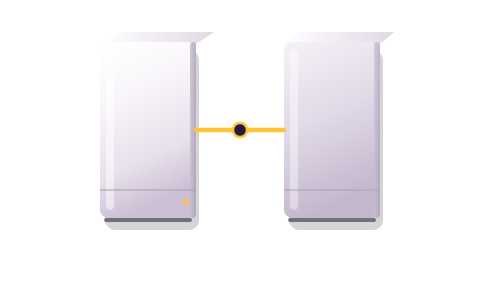
An Expansion adds 13.5 kWh of storage with no inverter of its own. It runs on the inverter in the Powerwall 3 it is paralleled with, which is why it is a cheaper way to buy the next 13.5 kWh than a second Powerwall.
Up to three can be added, and only to the leader unit: the one wired to the Gateway. A full system reaches four Powerwall 3 units with three Expansions, far more than a house needs.
Worth deciding before the first unit goes up rather than after: it changes which wall we choose and how much of it we leave clear.
Where it goes, and what the wall has to take
The warranty, stated properly
Ten years from installation. In the European warranty region the guarantee is 80% energy retention at the end of it, so at year ten the unit should still deliver at least 10.8 of its original 13.5 kWh.
Guaranteed energy retention at year ten, in the European warranty region.
Solar that goes to the house without touching the battery, at 97.5% efficiency.
Through the battery and back, measured from the panels rather than the battery terminals.
Cycling is unlimited, which is unusual and genuinely valuable. It is unlimited for defined uses: solar self-consumption, time-based control and backup. Those three cover how a domestic system is normally run. Other applications are capped on total throughput instead.
The warranty is held with Tesla and does not depend on us continuing to exist. What we are responsible for is the installation, which carries our own guarantee alongside the MCS certificate.
How an installation runs
A survey that starts with your bill
We want your annual kWh figure and, if you can get it, half-hourly smart meter data. What we are looking for is how much you use between four in the afternoon and midnight. That decides capacity; the roof decides the array. Most quotations answer only the second question.
Design, and the network application
System design, string layout, shading assessment, and the G98 notification or G99 application. A G99 approval has a response time attached and we build it into the programme rather than quoting a date we cannot keep.
Installation
Our own engineers, not a subcontracted crew. Array and DC containment first, then the Powerwall, the Gateway if specified, then the consumer unit work.
Commissioning and handover
Output set to the approved figure, operating mode configured, and the system brought onto the Tesla app in your name. MCS certificate, DNO paperwork, electrical certification and a walk round the system, and we set the app up with you rather than emailing a link.
The specification, in full
FAQs
Are you actually certified by Tesla, or just a reseller? +
We are a Tesla Powerwall Certified Installer. The certification is held by Qualis Energy Limited, the company ZenithNord trades as, and the work is carried out by our own engineers rather than subcontracted.
Do I need solar panels to have Powerwall 3? +
It is designed around solar, with the array wiring directly into its built-in inverter. It can be installed without an array, charging from a cheap overnight tariff, but you would be buying an integrated solar inverter and not using it, so we would talk you through the alternatives first.
Can Powerwall 3 be added to solar panels I already have? +
Yes. Whether that is the best answer depends on the age of the system, what inverter is there, and whether the array can usefully be re-strung into the Powerwall's own trackers. We look at that at survey.
How many can I have? +
Up to four Powerwall 3 units with up to three Expansion units on the leader: seven in total. Very few houses need beyond one Powerwall 3 and an Expansion.
Will it keep the house running in a power cut? +
Only in a backup configuration with a Backup Gateway 2, and only for the circuits on the protected side. Without a Gateway the system disconnects during an outage, as every grid-tied system must.
What happens on a three-phase supply? +
It can be installed, but during an outage it backs up only the loads on its own phase. Solar on a different phase will not charge it, and three-phase equipment must not sit on the backup side.
Can it go outside? +
Yes, IP55 with IP67 battery and power electronics, rated −20 °C to 50 °C. We still choose the wall carefully for access, cable run and noise.
How long will it last? +
Tesla warrant ten years at 80% retention with unlimited cycling in normal domestic use. Beyond that the cells degrade slowly rather than stopping; the warranty is the floor, not the life.
Is it zero-rated for VAT? +
Qualifying battery storage in residential property is zero-rated until 31 March 2027, after which the reduced rate is due to apply. That covers retrofit storage as well.
What does the app show me? +
Generation, what the house is drawing, state of charge and how the battery is being scheduled. We set it up in your name at handover.
Talk to us about Powerwall 3
Send us your annual kWh figure, your tariff and a rough idea of your evening routine, and we will tell you honestly whether Powerwall 3 is the right unit, and what output your network operator is likely to approve.
