Do solar panels work in winter? What to expect in the UK
Yes. Solar panels make electricity from daylight, not heat, so they keep working through a UK winter, including on cloudy days. They make less, because the days are short and the sun sits low: roughly a quarter to a third of a year's electricity comes between October and March. Cold weather is not the problem. Panels actually work slightly better when they are cool. A home battery helps by storing what the panels do make, and by filling up on cheap overnight electricity when the sun cannot keep up.
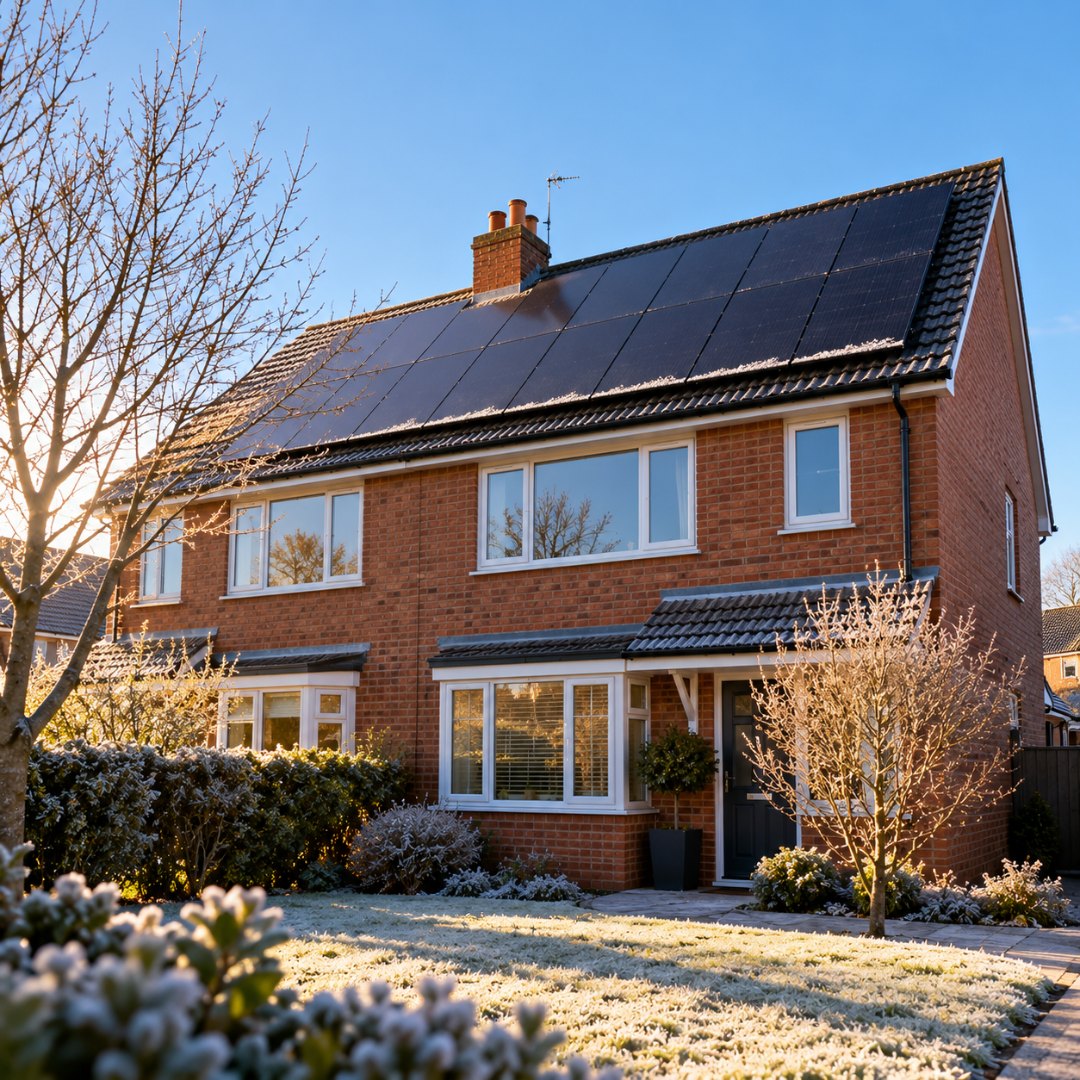
Why panels keep working when it is cold
Solar panels turn light into electricity. Their output is rated at a cell temperature of 25°C, and above that they lose a little power for every degree. The Green Age puts that loss at about 0.45% to 0.50% per degree for standard panels, so a bright, frosty morning can be one of the most efficient times of the year.
How much a typical system makes in winter
Renewable Energy Hub's figures for a typical 4 kW system in the north of England show how big the seasonal gap is.
For comparison, Ofgem's typical home uses about 2,500 kWh of electricity a year, which is just under 7 kWh a day. So in December the panels cover part of a day's use, while in June a system like this makes more than a typical home needs.
Where the year's electricity comes from
Most of the year's output arrives between April and September. Renewable Energy Hub, quoting the Energy Saving Trust, puts it at about 69%, which leaves around 31% for October to March.
The exact share depends on which way your roof faces, its angle and any shade.
What holds winter output back
- Short days: about 7 to 8 hours of daylight in December, against 16 to 17 hours in June.
- A low sun: it sits lower in the sky, so each hour of daylight carries less energy to the panels.
- Longer shadows: low winter sun lets trees, chimneys and nearby buildings shade panels that are clear in summer.
- Snow: a panel fully covered in snow stops generating until the snow slides off or melts.
What to do about snow on your panels
Leave it to slide off
Tilted panels usually shed snow on their own, and warmth from the panels helps melt the layer touching the glass. E.ON advises against climbing onto the roof or clearing panels with tools. A gentle spray from a hose at ground level is fine only if it is safe, and watch out for it refreezing.
If your monitoring app still shows no output a few days after the snow has gone, get the system checked.
What a battery adds in winter
The Energy Saving Trust says spare solar electricity exported to the grid earns around 12p a unit, while buying electricity typically costs more than twice that. Storing what you make and using it yourself is usually worth more, and in winter a battery can do a second job as well.
- Daytime
Panels first
Whatever the panels make powers the house, and anything left over charges the battery instead of going to the grid.
- Overnight
A cheap top-up
On a tariff with cheaper overnight electricity, the battery can fill up during those hours. Tesla says Powerwall can charge from the grid on a cheap overnight rate.
- Evening
Battery takes over
Stored electricity runs the house through the expensive early evening, when the panels have stopped.
- Storms
Ready for a power cut
Tesla's Storm Watch charges Powerwall to full when severe weather is forecast. Backup in the UK needs Tesla's Backup Gateway 2 fitted alongside it.
Getting the most from your panels in winter
- Run the dishwasher, washing machine and other big users around the middle of the day, when the panels make the most.
- If you have a battery, set it to charge in your cheapest overnight hours. In the Tesla app that is Settings, then Powerwall, then Savings.
- Keep some charge held back for power cuts with the Backup Reserve setting.
- Check your monitoring app now and then. A sudden drop on a bright day can mean new shade, snow or a fault.
How ZenithNord designs for the whole year
From a full year, not a summer day
We look at your electricity use and tariff, survey the roof and any shading, then size the panels and storage for winter as well as summer.
Powerwall 3
ZenithNord is a Tesla Powerwall Certified Installer through Qualis Energy Limited, the company we trade as. Powerwall 3 stores 13.5 kWh of usable electricity.
In writing first
You get a fixed written proposal before anything is fitted, so you know exactly what you are getting.
Want to see what solar panels and a battery would do for your home all year round? Book your usage-based quote with ZenithNord online: answer three quick questions and see a suggested system in about a minute.
Get a Solar QuoteQuestions people ask
Do solar panels work on cloudy days?
Yes. They generate from daylight that comes through cloud, so they keep producing on dull days, just less than in bright sunshine.
How much electricity do solar panels make in December?
Renewable Energy Hub's figures for a typical 4 kW system in the north of England are about 3 to 5 kWh a day in December, or 120 to 180 kWh for the month. In June the same system makes 16 to 18 kWh a day.
Do solar panels work better in the cold?
Slightly, yes. Panels are rated at a cell temperature of 25°C and lose a little power for each degree above that, so cool, bright days suit them well.
Should I clear snow off my solar panels?
Usually not. Tilted panels shed snow on their own. Never climb onto the roof or scrape the panels. A gentle hose from the ground is fine only if it is safe to do.
Is a solar battery worth it in winter?
It stores the electricity your panels make for the evening, and on a tariff with cheaper overnight rates it can fill up during those hours too. Whether it pays depends on your use and tariff, which is why we look at both before suggesting one.
Where these facts come from
- Monthly and daily output for a typical 4 kW system (June 16 to 18 kWh a day, December 3 to 5 kWh, December 120 to 180 kWh, June 550 to 600 k…checked 2026-10-24
- Nearly 69% of annual solar output between April and September, attributed to the Energy Saving Trustchecked 2026-10-24
- Panels work on cloudy days, export around 12p a unit, buying costs more than twice that, batteries store surplus solar (page updated 1 Octob…checked 2026-10-24
- Rated at 25°C, cold can improve efficiency, low sun and short days, snow sheds from tilted panels, do not climb on roofs or use tools, gentl…checked 2026-10-24
- Temperature coefficients: about -0.45% to -0.50% per degree for monocrystalline and polycrystalline panels, rated at 25°Cchecked 2026-10-24
- Ofgem medium electricity typical domestic consumption value of 2,500 kWh a year from 1 July 2026checked 2026-10-24
- Tesla UK Powerwall page: grid charging on a cheap overnight rate, Storm Watchchecked 2026-10-24
- Tesla Powerwall 3 UK datasheet: 13.5 kWh usable, Backup Gateway 2checked 2026-10-24
- Tesla UK support, Savings mode: Settings, Powerwall, Savings, Backup Reservechecked 2026-10-24
